Not realistically. Ostia Antica is south-west of Rome on the Metromare line, and Pompeii is beyond Naples, roughly two hours away by two trains. Doing both would mean rushing each and spending most of the day in transit. If you want both, give them separate days, and give Pompeii the full one.
The short answer: Ostia Antica, unless you can give Pompeii a full day
For most visitors based in Rome, Ostia Antica is the better choice. It is a single urban train ride from the city and fills a morning or afternoon, while Pompeii from Rome takes a full day. Choose Pompeii only if you can give up that whole day and the eruption of AD 79 is the reason you are going.
Ostia Antica is not a smaller Pompeii. It was Rome’s harbour town, and it was abandoned rather than buried, so what survives is a different kind of place: apartment blocks, baths, bars, a theatre.
Pompeii is the more famous site. Fame is not the same as fit.
Choose Ostia Antica if… / Choose Pompeii if…
Ostia Antica suits travellers on a short stay in Rome, families with young children, and anyone who would rather not spend four hours on trains, because it is close and far less crowded. Pompeii suits travellers with a spare full day, a specific interest in the AD 79 eruption, or onward plans in Campania that put it on the way.
Choose Ostia Antica if:
- You have three or four days in Rome and don’t want to give one of them to trains.
- You are travelling with young children who won’t manage a long transfer followed by hours on hot stone streets.
- You are visiting in July or August and want to be back in the city before the hottest part of the day.
- You have seen the Roman Forum and want to see how ordinary Romans lived. Roman Forum and Palatine guide
Choose Pompeii if:
- You can give it a whole day without cutting something in Rome you care about more.
- The eruption, and the moment the town stopped, is the reason you want to go.
- You are continuing to Naples, Sorrento or the Amalfi Coast, so Pompeii is on the way rather than a round trip you can book with us directly: Pompeii & Sorrento: Day Trip from Rome
- You have been to Rome before and have already done Ostia.



Getting there from Rome: half a day versus a full day
Ostia Antica wins on travel time by a wide margin. It is one urban train from Porta San Paolo station, beside Piramide metro, with no change. Pompeii needs a high-speed train to Naples and then a local train to the site, which adds up to roughly four hours of travel there and back.
For Ostia, Rome’s official tourism site, Turismo Roma, says the park “can be easily reached with the Rome-Lido train line, Ostia Antica stop.” The line is now branded Metromare and run by Cotral. Fodor’s puts the ride at about 35 minutes. Turismo Roma flags a steep pedestrian overpass at the station exit, which matters for anyone with limited mobility.
For Pompeii, the rail guide Seat61 lists about 70 minutes by high-speed train from Roma Termini to Napoli Centrale, then 36 minutes on the Circumvesuviana to Pompei Scavi–Villa dei Misteri. That is close to two hours each way before the change in Naples. Seat61’s advice for the site itself is to allow more time than you think you need.
A Pompeii day from Rome starts early and ends in the evening. An Ostia visit can be over by lunch.

Cost: entry is similar, the train is not
Ostia Antica is the cheaper day, and the difference is transport rather than admission. As of November 2026, the two sites’ full-price adult tickets were within a few euros of each other; confirm on the official sites. The gap is the train: Ostia is covered by a standard Rome transit ticket, Pompeii needs a high-speed fare to Naples and back.
The Lazio regional government’s fare rules list Rome’s standard BIT ticket as valid on the urban section of the Roma–Lido line. High-speed fares to Naples vary with the date and how far ahead you book, and they are the largest single cost of a Pompeii day.
The tickets work differently. The Parco archeologico di Ostia antica says its ticket is valid for eight consecutive days across all the park’s sites. The Archaeological Park of Pompeii sells a Pompeii Express ticket for the ancient city only, and a Pompeii Plus ticket that adds the suburban villas. Both Pompeii tickets are single entry: no leaving and coming back.

Crowds: Pompeii is one of Italy's busiest sites, Ostia Antica is not
Ostia Antica is far less crowded than Pompeii. Italy’s Ministry of Culture counted 4,267,233 visitors at Pompeii in 2024, the third-highest of any state site in the country. On the free-entry Sunday of 1 June 2025, the Ministry’s preliminary count showed 20,000 entries at Pompeii and 2,580 at Ostia Antica.
Pompeii now rations entry. The park introduced a daily limit of 20,000 admissions and named tickets from 15 November 2024, after a summer with more than 4 million visitors and a peak above 36,000 on one free Sunday. Between 16 March and 14 October, its ticket page splits entry into time slots, with up to 15,000 admissions in the morning and up to 5,000 in the afternoon.
Ostia Antica’s official visitor page mentions no cap or time slots, and tickets are sold at the gate. Whichever you choose, avoid the free first Sunday of the month for a first visit.

Physical demand and heat: both are hard on the feet, Pompeii more so
Pompeii is the more tiring day, because the walking comes on top of four hours of travel. Both sites mean hours on uneven ancient paving. Ostia Antica’s official site warns that the route “may appear bumpy.” Pompeii’s park issues heat advice that includes avoiding the hottest hours, especially with children and older visitors.
At Ostia Antica, the park says the road from the ticket office is fully wheelchair accessible as far as the Museo Ostiense, and visitors with reduced mobility can drive in with a permit. Turismo Roma recommends a hat, sunscreen and comfortable shoes in summer, because “the walk is long.”
At Pompeii, the park notes several public drinking fountains inside the excavations, marked on the entrance map. Its “Pompeii for all” route, from the Piazza Anfiteatro entrance, serves visitors with mobility difficulties

What you actually see: an ordinary port town versus a city stopped in AD 79
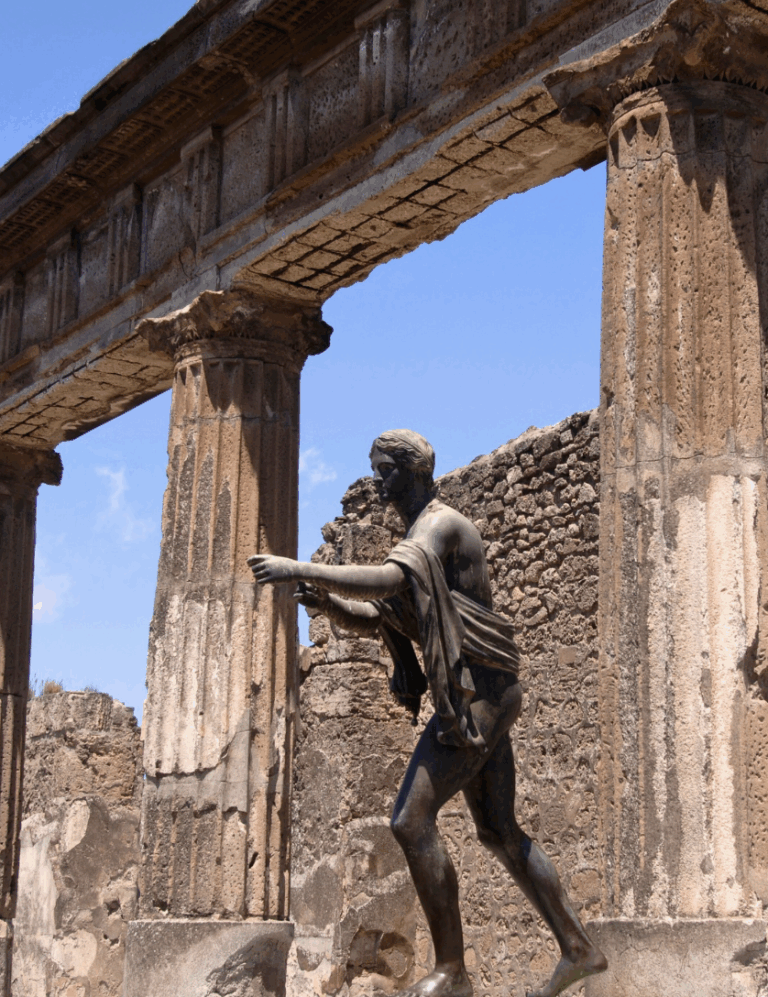
On this criterion alone, Pompeii wins for most first-time visitors: it has the more famous story and the images people come to see. Ostia Antica gives a fuller picture of everyday urban life. Pompeii was buried by Vesuvius in AD 79. Ostia was Rome’s harbour town and was abandoned, so its housing, baths and bars survive differently.
At Pompeii, CNN’s report on the visitor cap recounts that the eruption’s gases and ash killed most of the town’s inhabitants. RTÉ News describes many buildings, and some of the estimated 3,000 victims, as preserved. That moment is what Pompeii has and Ostia does not.
At Ostia Antica, Italy’s national tourism site, Italia.it, describes an outpost at the mouth of the Tiber that grew into a major commercial port. Turismo Roma says its theatre held up to 4,000 spectators and calls the thermopolium on Via di Diana the best preserved of the town’s bars.
Ostia’s distinctive sight is its apartment blocks, or insulae. Turismo Roma describes them as “public housing from the imperial era” and notes that the House of Diana rises four floors.


Frequently asked questions
Yes, and arguably more so. The Forum is the centre of Roman political and religious life. Ostia shows the rest: housing, shops, baths, a port. Turismo Roma describes its multi-storey apartment blocks as public housing from the imperial era. That kind of building is hard to picture from the Forum’s temples and basilicas alone.
The park recommends it rather than requiring it, according to its official ticket page. Tickets carry the visitor’s name and there is a daily limit of 20,000 entries. Between 16 March and 14 October, entry is split into time slots, with most capacity in the morning. In those months, booking ahead is the safe choice.
Not for a first visit to Pompeii. The Ministry of Culture’s preliminary count for the free Sunday of 1 June 2025 recorded 20,000 entries at Pompeii, the full daily limit. The park reported a peak above 36,000 on one free Sunday before the cap. Ostia Antica recorded 2,580 that same day, a fraction of the number.

Sources
- Parco archeologico di Ostia antica — “Opening hours and tickets” — https://ostiaantica.cultura.gov.it/en/opening-hours-tickets/
- Archaeological Park of Pompeii — “Timetables and tickets” — https://pompeiisites.org/en/?p=1119
- Archaeological Park of Pompeii — “Starting from 15 November, Pompeii to bring in nominative tickets and a daily limit of 20,000 admissions” — https://pompeiisites.org/en/?p=58523
- Archaeological Park of Pompeii — “Visiting the excavations of Pompeii: useful tips to protect yourself against the heat” — https://pompeiisites.org/en/?p=46666
- Ministero della Cultura — “MiC: la top 30 2024 dei luoghi della cultura statali” (13 May 2025) — https://cultura.gov.it/comunicato/27590
- Ministero della Cultura — “Cultura, 480 mila circa i visitatori nei musei statali nei due giorni di ingresso gratuito del 1-2 giugno” — https://cultura.gov.it/comunicato/27677
- Turismo Roma — “Roman baths, temples and taverns: a day in ancient Ostia” — https://turismoroma.it/en/page/roman-baths-temples-and-taverns-day-ancient-ostia
- Turismo Roma — “House of Diana, Insula of Jupiter and Ganymede and Insula of the Yellow Walls” — https://www.turismoroma.it/en/places/house-diana-insula-jupiter-and-ganymede-and-insula-yellow-walls
- Italia.it — “Parco Archeologico di Ostia Antica” — https://www.italia.it/it/lazio/roma/parco-archeologico-di-ostia-antica
- Cotral — “Metromare” — https://cotralspa.it/en/metromare/
- Regione Lazio — ATAC service contract, Annex 2 (fare rules) — https://regione.lazio.it/sites/default/files/documentazione/MOB_Contratto_Servizio_ATAC_Allegato2.pdf
- Fodor’s — “Getting Here and Around” (Ostia Antica) — https://www.fodors.com/world/europe/italy/side-trips-from-rome/travel-tips/getting-here-and-around-285506490
- Seat61 — “Day trip to Pompeii” — https://www.seat61.com/places-of-interest/day-trip-to-pompeii.htm
- CNN (via KVIA) — “Pompeii is limiting its daily visitor numbers” — https://kvia.com/?p=1315673
- RTÉ News — “Pompeii introduces daily limit of 20,000 visitors” — https://www.rte.ie/news/world/2024/1115/1481150-pompeii-tourism-visitor-limit